
What I Thought Was My Worst Job Became My Greatest Teacher
People sometimes ask me what my worst job was.
And for a long time, I knew exactly which one I’d name.
Not because of bad colleagues.
Not because of bad management.
Not even because of the work itself.
In fact, what I thought was my worst job started out as one of my favourites.
I worked in supported living with adults whose needs were complex and whose behaviours could be challenging. It wasn’t easy work, but it was meaningful work. I enjoyed it. I enjoyed the relationships, the routines, and even the unpredictability that came with supporting people whose needs were often misunderstood.
Challenging behaviour didn’t scare me.
I knew what I had signed up for.
Or at least, I thought I did.
For a long time, things were manageable.
Then one person’s behaviour began to change.
Not overnight.
Not dramatically.
Just enough at first to make everyone think, “We’ll get through this.”
And then it got worse.
And worse.
And worse.
The pacing became relentless.
Furniture was moved.
Walls were hit.
Cupboards emptied.
Property was damaged.
Staff were being injured.
Other residents were being affected.
Families became distressed.
Even those closest to him found themselves on the receiving end of his aggression.
Shift after shift, we documented.
ABC charts.
Daily notes.
Incident reports.
As seniors, we tried different approaches, different routines, different activities, different medications, hoping to find something that would help.
Everyone was trying to make sense of what was happening.
The family had their theories.
Management had theirs.
Staff had ours.
But our documentation kept telling the same story.
No obvious trigger.
No clear pattern.
Just a human being in distress and a level of need that had quietly grown beyond what we were equipped to manage.
And while people were explaining, justifying, and hoping, those closest to the fire were slowly burning.
As seniors, we kept trying.
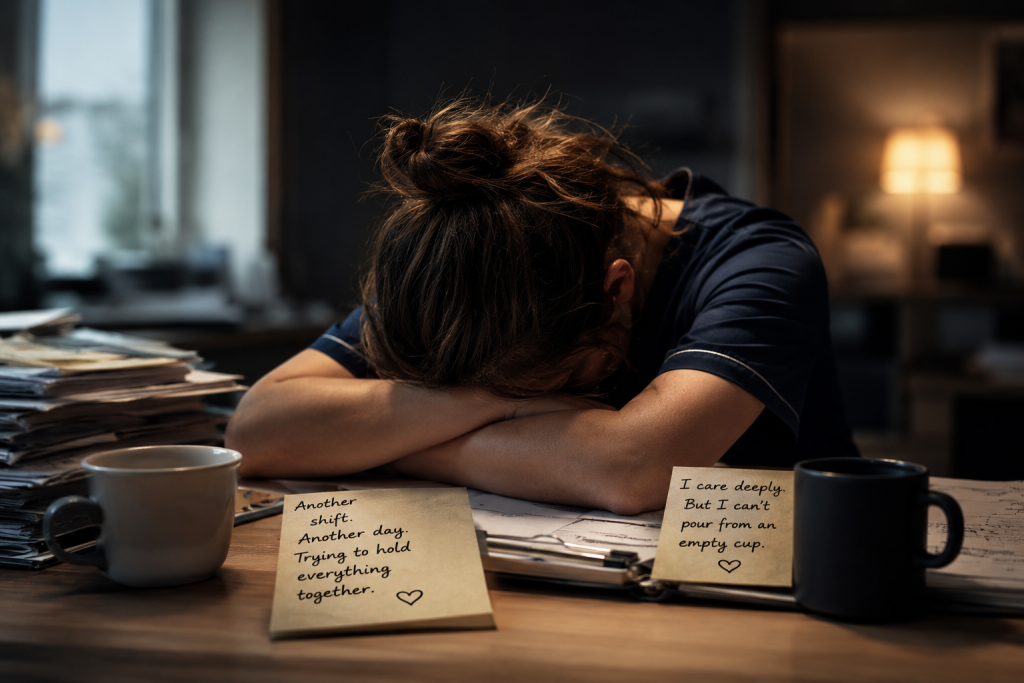
But eventually, there comes a point where resilience stops being resilience and becomes survival.
I didn’t recognise burnout at first.
Physically, I was fine.
I could recover after a shift.
Mentally was another story.
I reduced my shifts to two days a week.
But those two days would stay with me for four or five.
I wasn’t recovering.
I was merely counting down until I had to go back.
And that’s when I realised something important.
Burnout isn’t always exhaustion.
Sometimes it’s when your mind never gets to leave work, even after your body has come home.
And sometimes, by the time you realise you’re burning, you’ve been standing too close to the fire for far longer than you knew.
I stayed longer than I should have because that’s who I am.
I like solutions.
I like seeing things through.
I don’t walk away easily.
Part of me believed that if I just held on a little longer, something would change.
But eventually I realised that if I waited for everyone else to protect my wellbeing, I might be waiting forever.
So I handed in my resignation.
And something strange happened.
The very day I resigned, things finally moved.
Appropriate interventions were put in place.
Support arrived.
I remember leaving with mixed emotions.
Not bitterness.
Not anger.
Relief.
Because I knew I had made the right decision.
And strangely, I left happy.
Not because I was leaving the people I supported.
I cared deeply about them.
Not because I hated the job.
I didn’t.
I left happy because I had finally chosen myself.
If there’s one thing I took from that season, it’s this: noticing burnout early isn’t weakness. Sometimes it’s wisdom.
You can recover from tiredness.
You can recover from stress.
But there are some things you don’t want to wait to recover from.
I left that job with my health intact.
Not everyone gets to say that.
And looking back, that’s the part I’m most grateful for.
Looking back now, I understand why I once called it my worst job.
But time has a way of revealing things differently.
That job taught me about burnout.
It taught me about compassion.
It taught me that systems are made up of people trying to do their best, even when their best isn’t enough.
And perhaps most importantly, it taught me that choosing yourself isn’t selfish.
Sometimes staying isn’t strength.
Sometimes leaving is.
What I thought was my worst job became one of my greatest teachers.
And for that, strangely enough, I’m grateful.